DodoLab Radar
External, non-intrusive review: domain, email, certificates, website configuration, outdated software and leaked credentials. Executive report with a traffic-light summary and priorities.
Cybersecurity and data protection
We assess how exposed your company is on the internet, fix what is urgent and stay with you through ongoing protection, with your own dashboard to track every finding. We work with international frameworks such as ISO/IEC 27001, NIST CSF 2.0 and OWASP, and take your country's data protection law into account.
An incident does more than stop operations: it affects customer trust and may require explanations to the data protection authority. The good news is that most risks can be detected from the outside and fixed with concrete measures.
One technical methodology, with each country's legal layer.
External, non-intrusive review: domain, email, certificates, website configuration, outdated software and leaked credentials. Executive report with a traffic-light summary and priorities.
Every system we build ships with security controls: two-step verification for administrators, encryption, backups and access logs, following OWASP ASVS.
Monthly protection: updates, monitoring, tested backups, access reviews and a monthly report.
Controlled tests on websites, payments and integrations, following the OWASP Top 10 and ASVS, always under a written agreement and at mutually agreed times. Technical report and a retest after fixes.
Review of assistants and chatbots against the OWASP Top 10 for LLM applications: prompt injection, data leakage and tool permissions.
Data inventory, records of processing, privacy notices, security measures and vendor contracts, with a partner lawyer in each country.
What to do, who to notify and by when if something happens: procedure, contacts, notification templates and a yearly drill.
Radar reviews your company from the outside, the way anyone on the internet could, without touching your systems or asking for access. We analyze the domain and email (SPF, DKIM and DMARC), certificates, the website's security headers, visible software and whether team credentials appear in public leaks.
You get an executive report with a traffic-light summary for management, and a list of actions ranked by priority for your technical team or for us. It is the starting point to decide what to protect first.
No access to your systems
Executive report with traffic lights
Actions ranked by priority
Foundation for ongoing protection
With Shield, your company gets its own portal: what we found, how critical it is, who is fixing it and what happened in each incident.
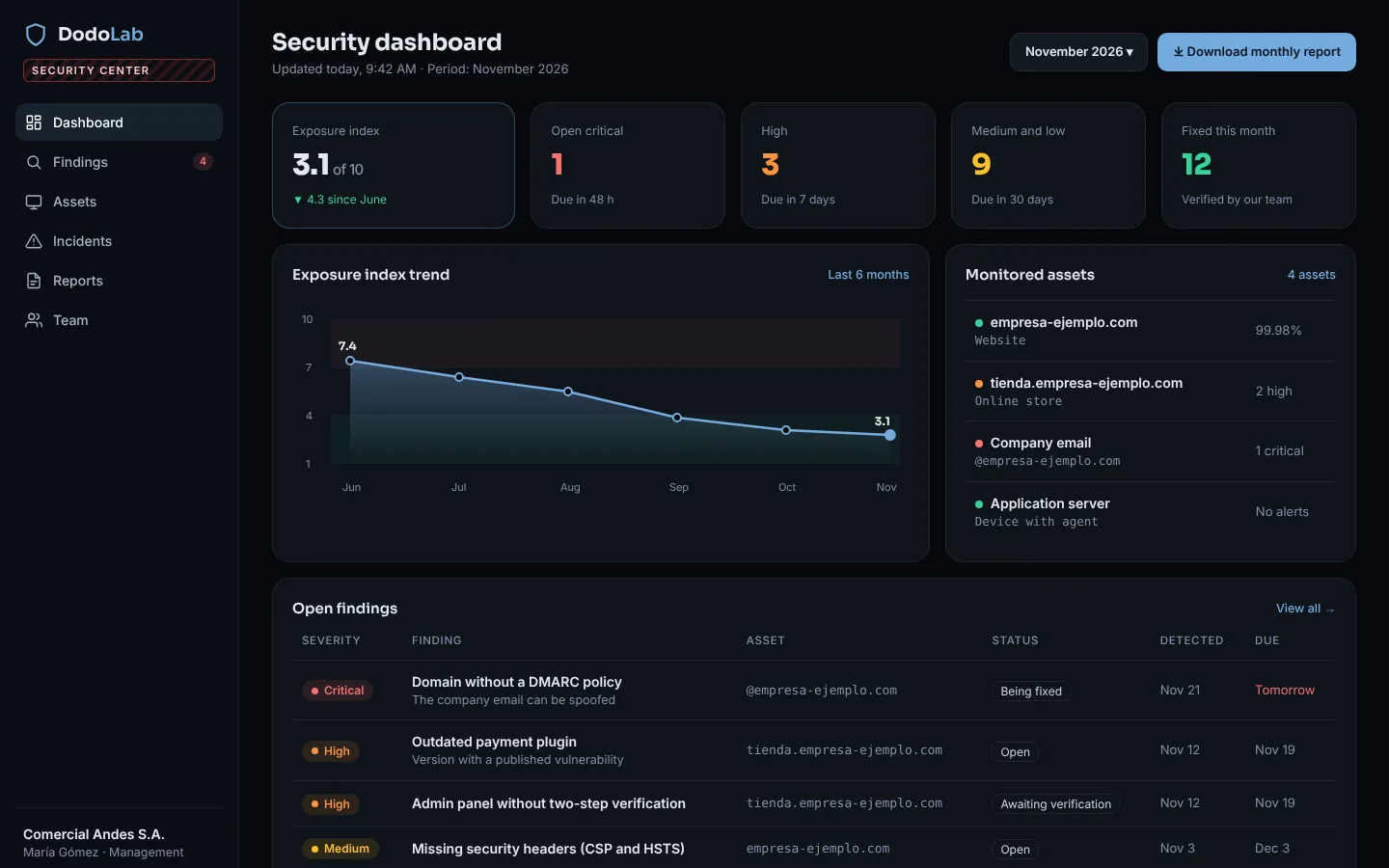
The exposure index and its month-by-month trend, open findings by severity with their fix deadlines, and the status of every monitored asset.
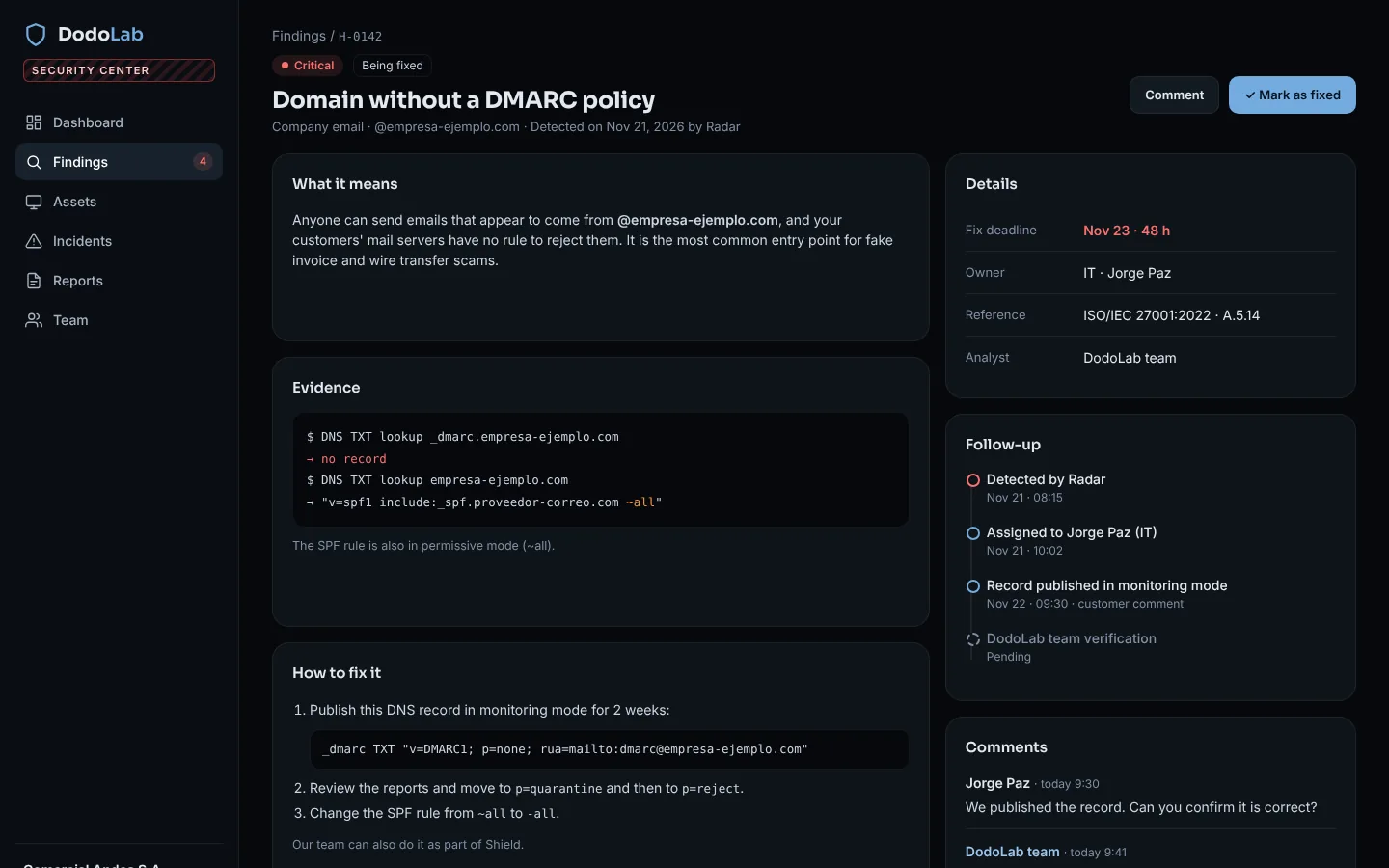
What it means in plain language, the technical evidence, how to fix it and who owns it. When your team fixes it, we verify it.
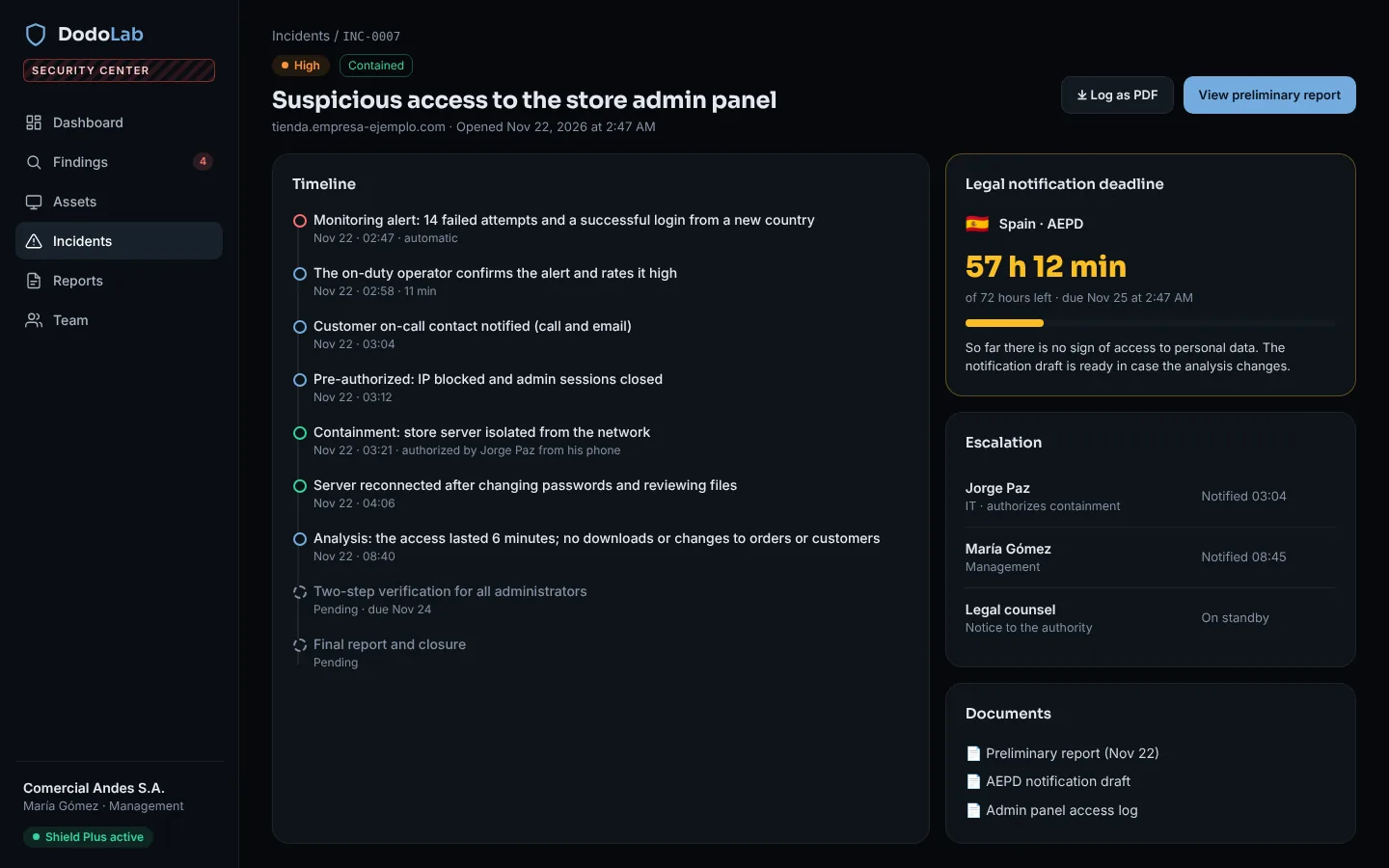
From alert to closure: what happened, what we did, who authorized it and how much time is left to notify the data protection authority.
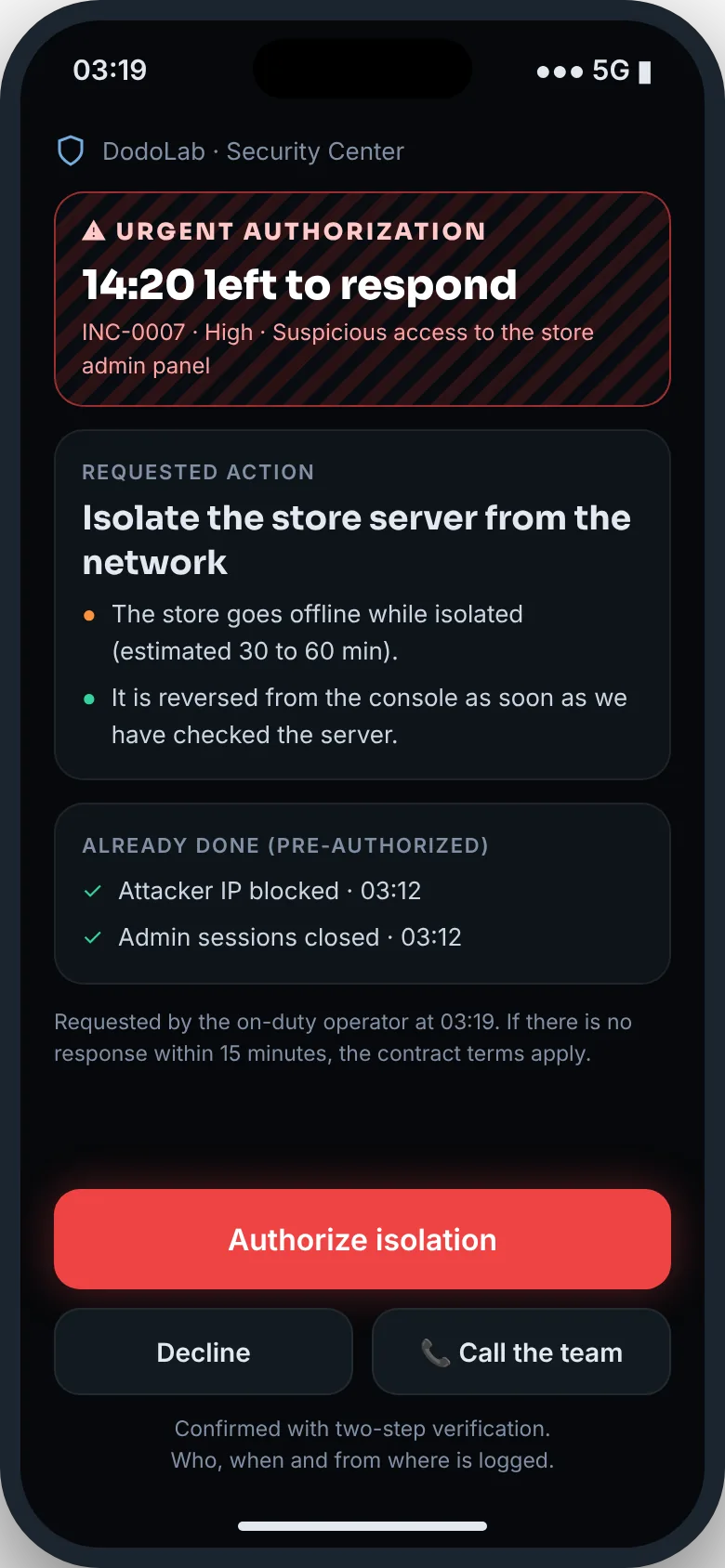
Actions that affect operations, such as isolating a server, are requested from the authorized technical contact, who approves or declines in seconds.
Illustrative example with fictitious data.
Clear results for management and for the technical team.
We can implement the fixes through our support and evolution service, or work alongside your team.
See support and evolutionWe use recognized standards so every recommendation is backed and auditable.
International standard for information security management. It guides controls, risk management and documentation.
Cybersecurity framework that organizes the work into six functions: govern, identify, protect, detect, respond and recover.
The most critical web application risks. The basis of our tests for websites, stores and systems.
Application Security Verification Standard. We use it as the minimum requirement in every build and in penetration tests.
Risks specific to AI applications: prompt injection, data leakage and tool abuse.
GDPR in Spain, LGPD in Brazil, the laws of Argentina, Chile and Mexico, and US state and sector laws: deadlines, authorities and obligations in each market.
We apply these frameworks as working references. ISO/IEC 27001 certification is granted by an accredited certification body; if your company is pursuing it, we help you prepare.
The technical foundation is the same; the law, the authority and the incident notification deadlines change.
General reference, updated November 2026. Several of these laws are being reformed; the legal side of each project is reviewed by a local lawyer.
Which systems your company uses, what data it handles and what concerns you today.
We define the scope, sign the authorization and agree on testing times.
External, non-intrusive review, with a report and priorities.
With your team or ours, starting with what is critical.
Monthly Shield service, periodic testing and an incident response plan.
No. It is an external, non-intrusive review: we look at what anyone can see from the internet, without accessing your systems or trying passwords.
Radar shows your overall exposure from the outside. A penetration test goes deeper: it tries to exploit flaws in a website, API or integration, always under a written agreement and at mutually agreed times, so operations are not affected.
The contract defines which actions we take without asking (blocking an IP or closing sessions) and which need authorization (isolating a server or taking a site offline). Those are requested from the technical contact, who approves from their phone with two-step verification; if nobody responds within the agreed time, the contract terms apply. Everything is logged and can be reversed.
We do not issue certifications: that is done by an accredited body. We apply the standard as a guide and help you prepare the controls and documentation if you are pursuing certification.
Yes. With the Compliance roadmap we prepare the technical and documentation side, and a partner lawyer in your country reviews and signs off the legal side.
Yes. With Secure AI we check what the assistant can reveal, what permissions its tools have and how it responds to manipulation attempts.
No. We review websites and systems from any provider, always with the owner's authorization.
It depends on the size of the company and the systems to review. After a first conversation, we send a proposal with scope, timeline and price.
Tell us which systems your company uses and what concerns you. We will propose the Radar scope and the next steps.