Online Booking Systems: When Is a Custom Solution Worth It?
An online booking system helps businesses manage appointments, staff availability, payments, and customer confirmations. Learn when an existing platform is sufficient and when developing a custom booking solution makes business sense.
By serginho 7 min read Updated November 11, 2026
In this article
- What is an online booking system?
- When manual appointment management becomes a problem
- The benefits of accepting bookings through your website
- Custom booking software or a subscription-based platform?
- Online appointment systems for clinics and medical practices
- Booking systems for beauty centers and professional services
A business that receives appointments through phone calls, WhatsApp, or email can usually manage requests without much difficulty when customer volume is relatively low. However, as demand grows, administrative tasks begin to consume more time: checking available slots, answering repetitive questions, rescheduling appointments, recording cancellations, and confirming whether customers have paid their deposits.
This situation is common in medical practices, clinics, beauty centers, salons, and professional service businesses. It also affects hotels, restaurants, and other companies that operate through reservations. Although their services differ, they all need reliable information about the availability of staff, facilities, equipment, or services.
An online booking and reservation system can help organize these processes while allowing customers to check availability and make bookings directly through a company's website. Depending on the business requirements, the solution may involve an existing subscription-based platform or a custom application developed specifically for its operations.
The decision to build a proprietary system should consider booking volume, scheduling rules, the number of employees, business locations, and required integrations. Not every company needs to develop its own software, but not every commercial booking platform can accommodate the way a particular business operates.
What is an online booking system?
An online booking system is an application that allows customers to check availability, select dates and times, and submit appointment or reservation requests. It can operate directly within a company's website or through an external platform that manages bookings.
A basic system displays available time slots, collects customer information, and sends confirmations. More advanced solutions may include advance payments, cancellation policies, staff allocation, room or equipment management, automated reminders, and multiple-location administration.
For example, a medical clinic may offer appointments across several specialties, each requiring different consultation lengths and qualified professionals. The system must consider these conditions before displaying available appointments. In a beauty center, availability may depend not only on the employee's schedule but also on whether a treatment room or specialized piece of equipment is available.
These differences explain why an online booking system is more than a calendar embedded in a website. To work reliably, it must reflect the actual conditions under which the business delivers its services.
When manual appointment management becomes a problem
Manual scheduling can remain practical for a long time, particularly when a company has a small team and a limited number of daily appointments. Problems begin when employees spend a significant part of their working day checking information that customers could access themselves.
A common example occurs when someone asks about an available appointment through WhatsApp, receives a response, and takes several hours to confirm. During that period, another customer may request the same time slot. Without a centralized, updated schedule, the business risks confirming two appointments for the same employee.
Mistakes can also happen when several team members manage requests. An appointment recorded in one calendar may not appear in another, a cancellation may remain unprocessed, or a schedule change may only be communicated to one employee.
Beyond the administrative workload, these situations affect the customer experience. Someone who needs to book a medical appointment outside business hours may abandon the process if they have to wait until the following day to check availability.
When these problems become frequent, introducing an online booking system can improve operational coordination and reduce reliance on manual confirmations.
The benefits of accepting bookings through your website
Allowing customers to schedule appointments directly through a website makes services more accessible without requiring an employee to respond to every request.
Customers can select a service or specialty, check available times, and complete a booking from their phone or computer. If automated confirmations are enabled, they can receive the appointment details without waiting for a manual response.
For the business, this creates a centralized record of bookings and changes. Employees can review upcoming appointments, identify cancellations, and prepare the resources needed to deliver each service.
Another advantage is the opportunity to present relevant commercial information during the booking process. A beauty center might offer complementary treatments, while a professional services company could allow customers to choose between in-person and virtual appointments.
However, adding online booking does not automatically increase sales or customer volume. Results also depend on how easy the booking process is, whether service descriptions are clear, how trustworthy the website appears, and whether suitable appointment times are actually available.
Custom booking software or a subscription-based platform?
Many commercial platforms provide online booking functionality through monthly or annual subscriptions. For businesses with relatively standard scheduling requirements, these tools may solve the problem without a significant initial development investment.
For example, an independent professional offering appointments of a fixed duration may find that an existing scheduling application meets all their needs. If the main requirements are displaying availability, accepting reservations, and sending reminders, custom software may add unnecessary cost and complexity.
A custom booking system becomes more relevant when business rules require specialized functionality. This may happen when availability depends on several employees and resources, different customer groups have different booking conditions, or appointments must be connected to other internal processes.
It may also make sense when a company operates multiple locations, needs to integrate bookings with an existing management system, or follows specific payment and confirmation procedures.
The comparison should account for initial investment, subscription fees, transaction charges where applicable, ongoing maintenance, and future growth. An off-the-shelf platform may remain sufficient for years, while custom development can become justified when existing products cannot support essential business requirements.
For a broader comparison, read our article on custom software vs. SaaS and which option is better for an SME.
Online appointment systems for clinics and medical practices
Medical scheduling requires more than assigning a patient to an available time slot. Clinics may need to coordinate specialties, healthcare professionals, consultation lengths, treatment rooms, and equipment. Some procedures also require preparation time or specific resources.
For example, a medical center may have professionals working across different locations or sharing consultation rooms at different times. The scheduling system must coordinate these conditions to prevent conflicts and display only appointments that can actually be booked.
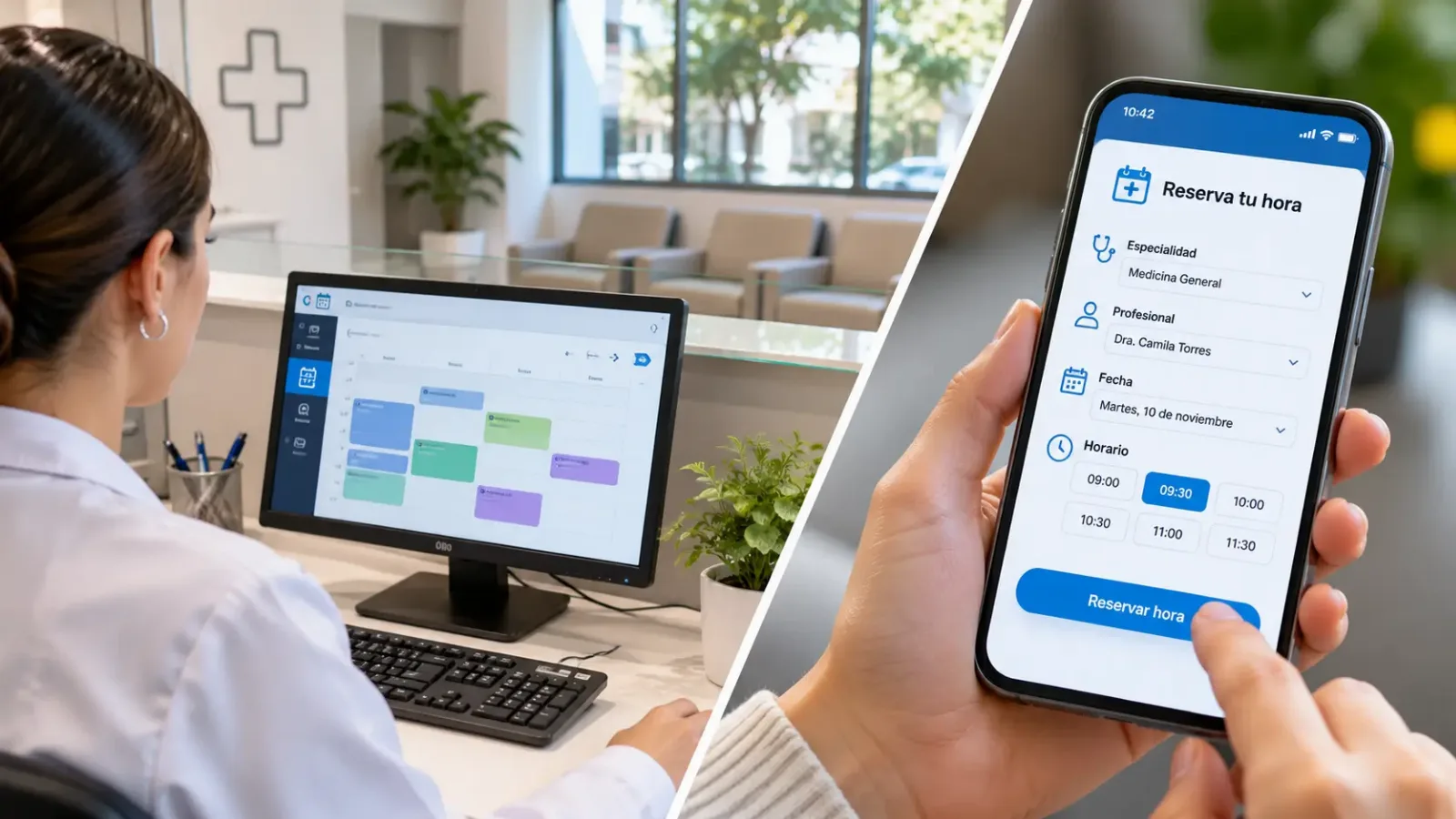
From the patient's perspective, the process should be straightforward. They select a specialty, choose a professional when appropriate, review availability, and confirm the appointment from their phone. Reception staff, meanwhile, have access to a centralized schedule for reviewing upcoming consultations, recording cancellations, and managing changes.
Healthcare businesses must also consider personal data protection. Patient information may be subject to specific privacy and security requirements depending on where the organization operates and whose information it processes.
For example, businesses operating in Argentina must consider Law 25,326 on personal data protection. Organizations subject to the European Union's General Data Protection Regulation (GDPR) may face additional requirements, particularly when processing health information, which receives special protection under that regulation.
A medical booking system should therefore collect only the information necessary for scheduling, establish appropriate access permissions, and prevent unauthorized disclosure of patient data. If the application also handles medical records, prescriptions, or clinical information, additional controls and legal considerations will be necessary.
Booking systems for beauty centers and professional services
Beauty centers, hair salons, wellness businesses, and other appointment-based services can also benefit from digital scheduling. However, their operational requirements may differ considerably from those of a medical clinic.
A beauty center may offer treatments lasting thirty, sixty, or ninety minutes, delivered by professionals with different qualifications. Some services require dedicated rooms or shared equipment, meaning availability depends on more than an employee's calendar.
A booking system can coordinate these conditions, prevent incompatible reservations, and allow customers to choose the services they want. It can also support deposits, promotional offers, and reminders according to the company's commercial policies.
For businesses with multiple branches, centralized administration can provide visibility into each location's availability while maintaining consistent s
Frequently asked questions
1. Is it better to use an existing booking platform or develop custom software?
It depends on the business requirements. An existing platform is often more cost-effective when scheduling procedures are straightforward and the available features cover daily operations. Custom development may be worthwhile when a business has specialized rules, multiple locations, complex resource allocation, or integrations that commercial platforms cannot support.
2. Can an online booking system integrate with Stripe, PayPal, or Mercado Pago?
Yes. When compatible integration methods are available, a booking application can accept deposits or full payments and update reservation statuses after verifying transactions. Availability depends on the provider, country, account configuration, and technical requirements.
3. Can online booking functionality be added to an existing website?
Yes. Depending on the website's technology and the booking solution, scheduling functionality can be incorporated through an integration, a dedicated module, or a connected application. Rebuilding the entire website is not always necessary.
Was this article helpful?
Get an assessment